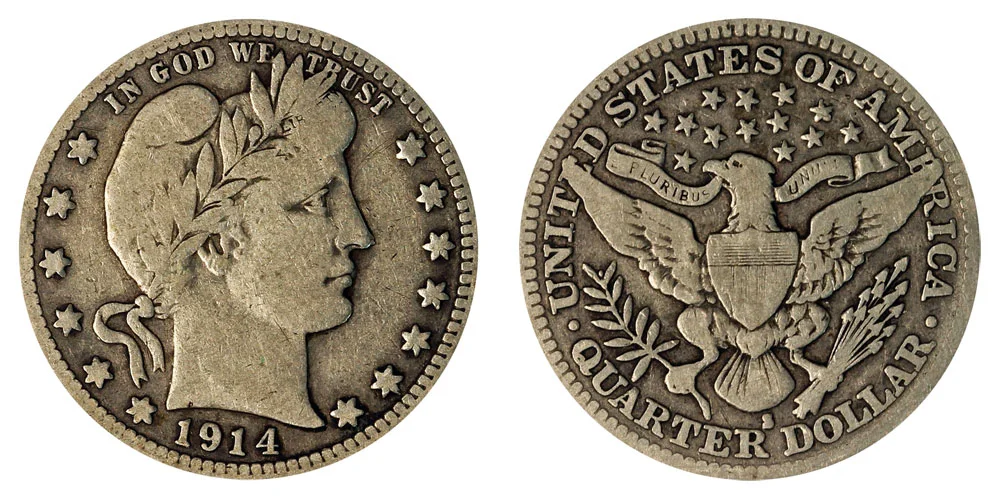
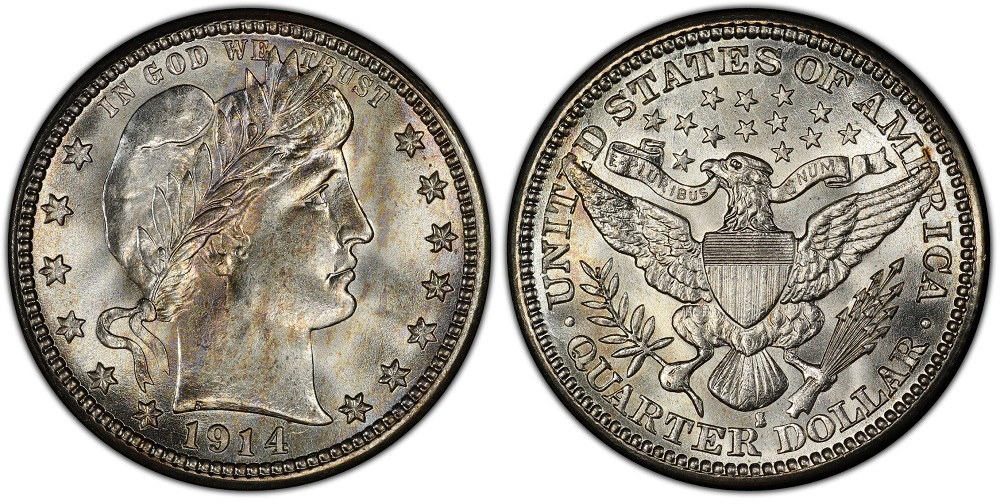
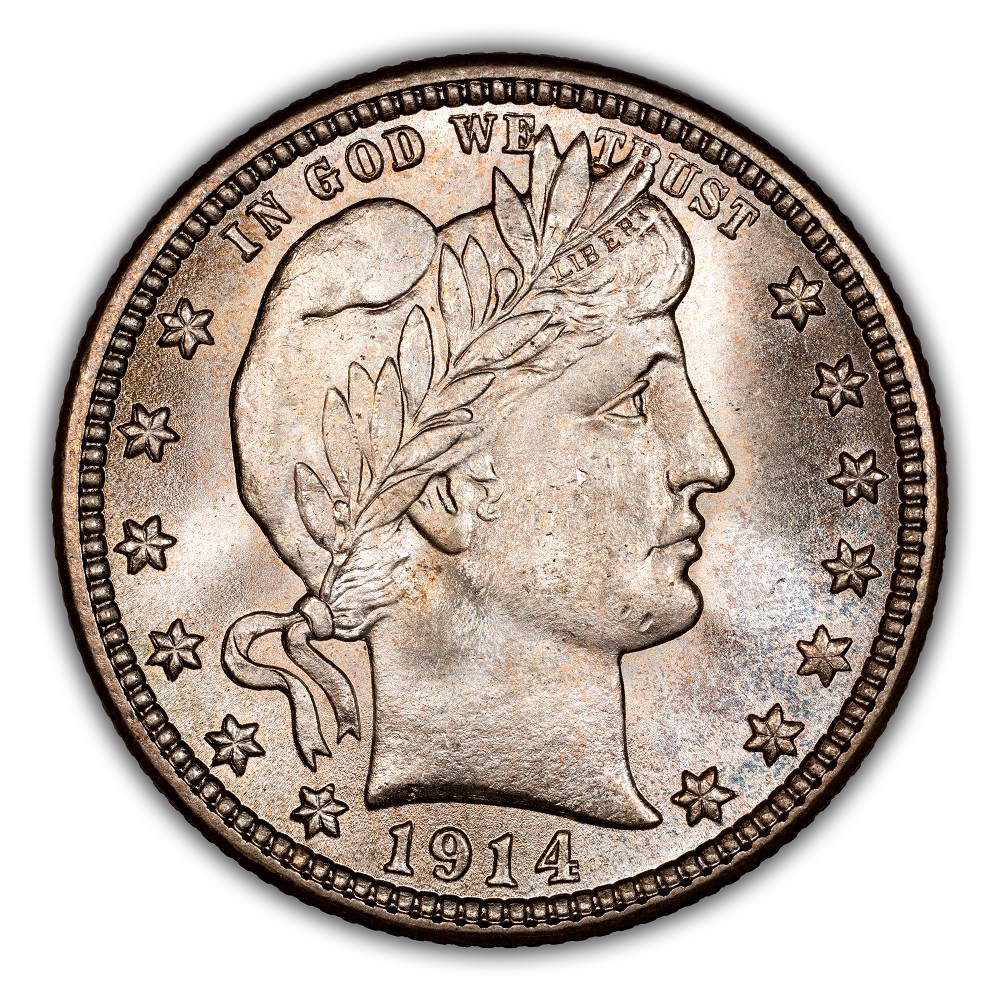
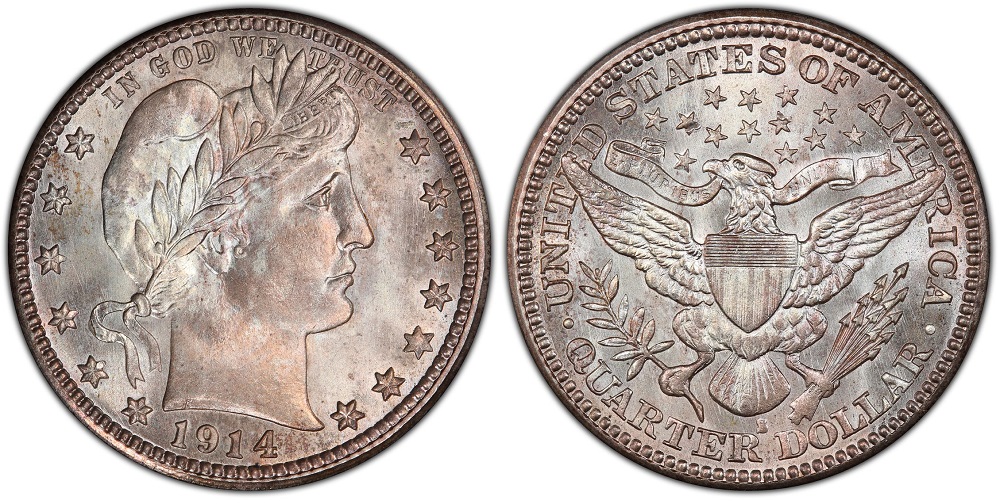
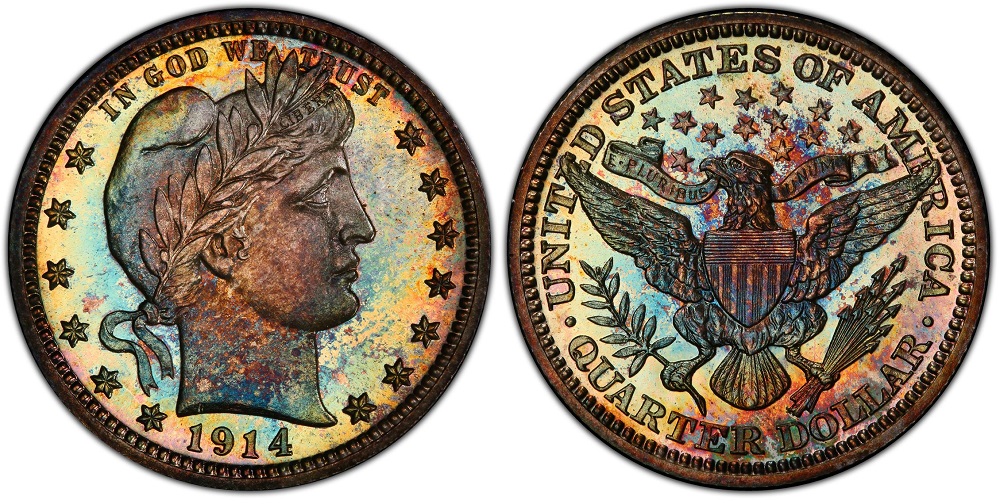
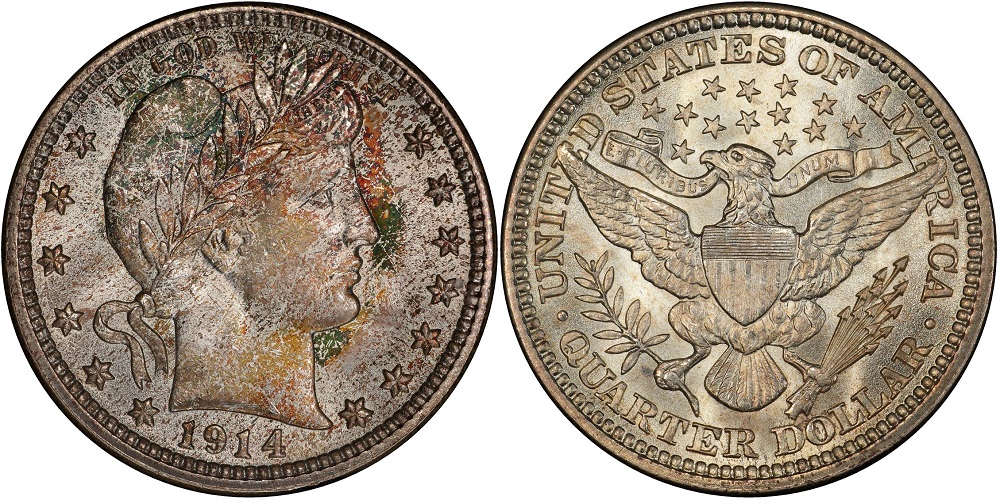
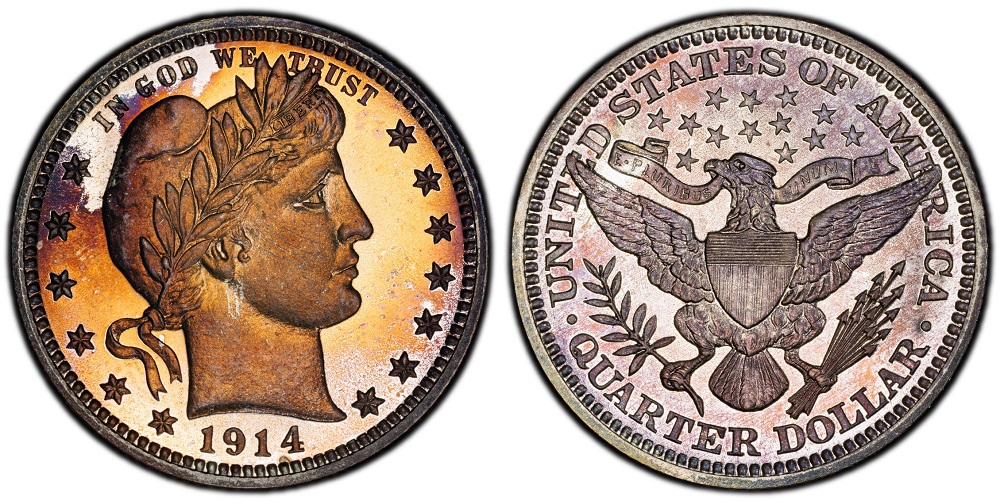
A 1914-S Barber quarter sold for $29,375 (PCGS MS-67, Legend Rare Coin Auctions, Sept. 2022). Common-date Philadelphias fetch as little as $18 worn — but the San Francisco semi-key and a handful of die varieties can push your coin into four or five figures. Use the free calculator below to find out exactly where yours stands.
Select your coin's mint mark, condition, and any known errors. The calculator returns a value estimate backed by recent auction data.
Not sure which mint mark or condition applies to your coin? There's a 1914 Quarter Coin Value Checker tool that lets you upload a photo for an AI-based identification before using this calculator.
Tell us what you see on your coin in plain language. The more detail you provide, the more specific the assessment.
Skipped the calculator? It takes under 30 seconds to get a value estimate based on your specific mint mark, grade, and error — no login needed.
The 1914-S is the most valuable business-strike issue of the year. Use this checker to determine if your coin qualifies.
No mint mark or D mint mark on reverse. Worth roughly $18–$30 worn, $55–$100 in Fine/XF. Tens of thousands survive in circulated condition. A solid type coin for silver value, but not a key date.
S mint mark on reverse, between eagle and QUARTER DOLLAR text. Only 264,000 minted. Worth $100+ even heavily worn; $500–$1,100+ in Fine/XF; over $2,000 in Mint State. A genuine semi-key date in the Barber quarter series.
This table covers all major 1914 quarter varieties across four condition tiers. For a complete step-by-step 1914 quarter identification breakdown, see this detailed Barber quarter reference guide to identify and grade your coin. Values reflect recent auction data and dealer buy/sell spreads. Signature variety (1914-S) row is highlighted in gold; rarest variety (Proof) is highlighted in red.
| Variety | Worn (G–VG) | Circulated (F–XF) | Uncirculated (MS60–63) | Gem MS (MS64–67) |
|---|---|---|---|---|
| 1914 Philadelphia Common | $18 – $25 | $28 – $100 | $237 – $345 | $565 – $9,900 |
| 1914-D Denver Common-D | $18 – $25 | $28 – $100 | $245 – $350 | $565 – $7,600+ |
| 1914-S San Francisco ★ Semi-Key | $93 – $150 | $309 – $1,100 | $2,100 – $3,250 | $3,657 – $29,375 |
| 1914-D DDO FS-101 Variety | $75 – $120 | $150 – $400 | $400 – $700 | $700 – $1,000+ |
| 1914 Proof Only 380 Made | — | — | $595 – $800 (PR62–63) | $900 – $36,000+ (PR64–PR68) |
📱 CoinHix is a fast on-the-go way to scan your coin and get an instant value estimate before heading to a coin show — a coin identifier and value app.
Jump to any section for the information you need.
Four major collectible varieties exist for the 1914 Barber quarter series. Each one can dramatically change what your coin is worth. The guide below covers diagnostic features, market premiums, and how to spot each variety with a standard 10× loupe.
The 1914-S Barber quarter was struck at the San Francisco Mint with a business-strike mintage of just 264,000 pieces. This is the lowest production of any 1914 quarter by far, occurring because the Mint balanced orders against circulation demand in the western region. The combination of low mintage and decades of heavy use left very few specimens in collectible condition today.
Recognition begins on the reverse. Between the eagle's tail feathers and the denomination QUARTER DOLLAR, look for a capital S mint mark. Under a loupe, the S should appear sharp and evenly punched. Beware of cleaned or altered coins where a D mark may have been tampered with — original luster in the recesses surrounding the mint mark letter is the best authenticity indicator.
Collector demand for this semi-key date remains consistently strong. Even a heavily worn G-4 example brings roughly $93–$150, compared to $18 for a similarly worn Philadelphia coin. In VF-20, values exceed $300–$500. A PCGS MS-67 example achieved $29,375 at Legend Rare Coin Auctions in September 2022, confirming sustained institutional-level demand at the top of the grade scale.
The 1914-D DDO FS-101, also catalogued as VP-001, is a recognized doubled die obverse variety produced when the Denver Mint's working die received a misaligned second hub impression during preparation. The doubling affects IN GOD WE TRUST, the stars, and Liberty's ribbon ends — areas that received the double hub pressure. This variety is listed in both the PCGS CoinFacts database and CONECA records.
Visual identification requires a minimum 10× loupe and good lighting. Examine IN GOD WE TRUST on the obverse: look for a distinct shelf or step on the letter serifs, particularly on the G, O, D, W, and E characters. The doubling is mechanical rather than machine (which would show flat shelf doubling), appearing as a slight displacement with definition on both layers. Stars 1–3 and the ribbon ends at Liberty's neck also show the secondary impression.
Because the 1914-D is a relatively common date, this variety represents one of the best cherrypick opportunities in late-series Barber quarters. Most dealers miss it because they examine the coin at a glance rather than under magnification. A circulated VF example brings roughly $150–$300 over the regular 1914-D price, while gem Mint State coins with strong doubling can command $700–$1,000 or more from specialists.
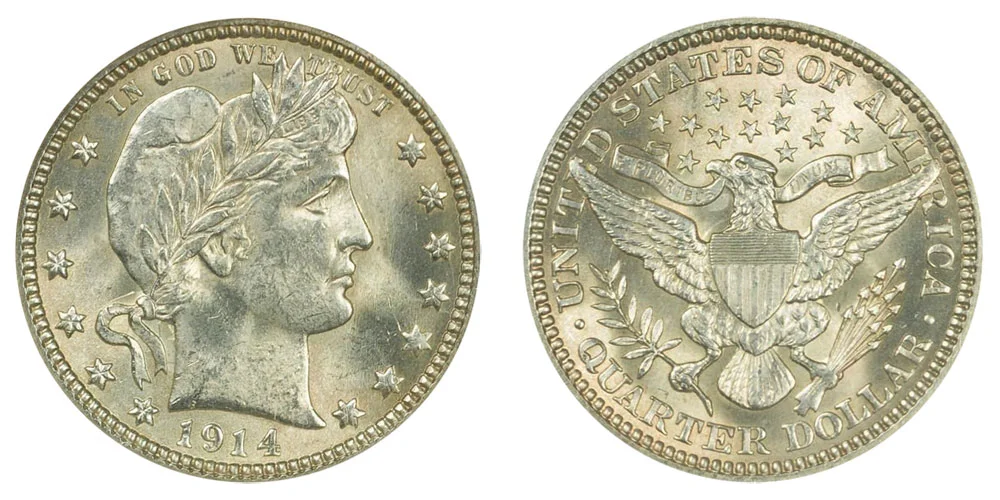
The 1914/4 Repunched Date variety on the San Francisco issue (catalogued RPD-S in the Barber Quarters Variety Survey) resulted from the date being punched into the working die twice at a slightly different position. The second punch of the final digit 4 is displaced to the south of the primary punch, leaving a ghost impression of the earlier strike below or at the base of the numeral. This is a die-preparation error, not a planchet error.
Detection requires careful examination of the date digits under at least 10× magnification. Focus specifically on the final digit 4 in the date. Look for a secondary outline — often described as a shadow or shelf — positioned slightly south of the primary 4. In well-preserved specimens the doubling can sometimes be seen with the naked eye under strong raking light, but a loupe is almost always necessary for confident attribution. The other three digits are not typically affected.
Because this variety occurs exclusively on the 1914-S — an already scarce semi-key date — attributed examples command a premium on top of the normal 1914-S premium. Any coin confirmed as RPD-S should be considered for professional grading and attribution by PCGS or NGC, as the combination of semi-key date plus documented variety can attract advanced Barber quarter specialists who actively compete for such pieces.
The 1914 Proof Barber quarter holds the distinction of having the lowest mintage of any proof Barber quarter struck between 1858 and the series' end in 1916 — just 380 impressions. Proof coinage at the Philadelphia Mint by 1914 had become increasingly unpopular with collectors, and the order quantities had been declining steadily from over 1,200 in the early 1900s. The ultra-low 380-piece total reflects near-complete collector indifference to the proof program in the final years of the Barber series.
Identification of a genuine proof relies on mirror-like (deeply reflective) fields contrasting with frosted or satin design devices — the result of specially prepared dies and polished planchets. Examine the flat areas (fields) around Liberty's portrait: they should show a perfect mirror reflection. The devices (portrait, lettering, stars) may show either a brilliant or a cameo frosted contrast depending on the die state at time of striking. A loupe will also reveal the extremely sharp wire rims produced by the proof striking process.
Market performance for the 1914 Proof has been exceptional. A PCGS PR-68+ Cameo example sold for $36,000 at Heritage Auctions in April 2021 — the most dramatic result on record for this issue. More typical PR-62 to PR-64 examples sell in the $595–$1,300 range based on recent data. Any problem-free proof deserves PCGS or NGC certification, as the rarity is real and counterfeit business-strike coins artificially brightened to simulate proof surfaces do exist.
Found one of these varieties on your coin? Run it through the calculator to get a value estimate that accounts for your specific mint, grade, and error combination.
| Mint / Issue | Mint Mark | Mintage | Typical Survival Grade | Status |
|---|---|---|---|---|
| Philadelphia | None | 6,244,230 | G-VG (heavily worn survivors) | Common |
| Denver | D | 3,046,000 | G-VG; note soft strike on eagle's claws | Common |
| San Francisco | S | 264,000 | G-F; scarce in VF+; rare in MS | Semi-Key |
| Philadelphia Proof | None | 380 | PR-62 to PR-65 for most survivors | Rare / Specialist |
| Total (all issues) | — | 9,554,610 | — | — |
Note: The 1914-S has a very low survival rate in VF and better. Most examples encountered at coin shows or online are in the Good to Fine range. Fine or better examples are scarce enough that any 1914-S deserves careful examination before purchase or sale.
Condition is the single biggest value driver for the 1914-S and for proof issues. A coin jumping one grade tier can double or triple in value. Here's how to place yours.
Portrait and eagle visible but nearly flat. LIBERTY fully worn from headband. Date and mint mark still readable. Most circulated survivors fall here. Silver melt value is the floor.
Fine: all letters of LIBERTY visible but flat. XF: LIBERTY sharp, hair detail above forehead visible, eagle's feathers separated. High points show flat spots but no complete smoothing.
No trace of wear. Cartwheel luster present but may have contact marks. Check Liberty's hair above the forehead and the eagle's neck — any flat gray spots indicate a circulated coin, not uncirculated.
Full original luster, sharp strike, minimal contact marks in focal areas. MS65+ requires clean cheek field and brilliant eagle reverse. MS67 examples are exceptional — fewer than a handful exist for the 1914-S.
🔬 Cross-check your grade assessment against actual graded examples using CoinHix — upload a photo to compare your coin's surface detail against certified specimens — a coin identifier and value app.
The right venue depends on your coin's value tier. A $20 worn Philadelphia coin goes to eBay; a $29,000 1914-S MS-67 goes to a major auction house. Match the venue to the value.
The world's largest numismatic auction house. If you have a 1914-S in Fine or better, a DDO FS-101 in gem grade, or a proof Barber quarter, Heritage reaches the widest pool of advanced collectors. Expect to pay a seller's commission but achieve top market prices. Consign directly through their website or at a coin show where they have a table.
eBay is the largest marketplace for circulated Barber quarters in the $15–$500 range. See recently sold prices for 1914 Barber quarters including completed eBay listings to benchmark your coin before listing. Use auction format for scarce varieties; buy-it-now for common-date circulation strikes. Always include clear, high-resolution photos and disclose any cleaning or damage.
A local coin dealer will pay wholesale (typically 50–70% of retail) for instant cash. This is ideal for worn common-date Philadelphia or Denver coins where the silver melt value is close to the numismatic premium. Bring multiple coins at once — dealers offer better prices when buying in bulk. Always get quotes from two or three shops before selling.
The r/Coins4Sale and r/CoinSwap communities offer collector-to-collector pricing — often better than dealer wholesale but less than auction hammer prices. Works well for mid-grade 1914-S coins ($100–$500 range) and verified variety coins like the DDO FS-101. Provide PCGS/NGC certification numbers if graded, or clear photos with a description of condition.
A 1914 Philadelphia Barber quarter is worth around $18–$28 in Good condition and $55–$100 in Extremely Fine. Mint State examples range from roughly $237 (MS60) to over $1,500 (MS66). The 1914-S is significantly more valuable due to its semi-key status with only 264,000 minted, while the 1914-D falls between the two in most grades.
Flip the coin to its reverse side. Look directly below the eagle and above the word QUARTER DOLLAR for a small mint mark letter. A capital S indicates San Francisco. No letter means Philadelphia; a D means Denver. The S is the key find — with only 264,000 struck, even worn examples are worth $100 or more, compared to under $20 for a worn Philadelphia coin.
The most valuable regular-issue 1914 quarter is the 1914-S in top condition. A PCGS MS-67 example sold for $29,375 through Legend Rare Coin Auctions in September 2022. The 1914-P can also reach four figures in the highest Mint State grades — a PCGS MS-67+ sold for $9,900 via Stack's Bowers in March 2020. Proof issues with only 380 minted can top $8,000 in PR-68.
The 1914-D Doubled Die Obverse FS-101 (VP-001) is a recognized PCGS and CONECA variety showing doubling on IN GOD WE TRUST, stars, and ribbon ends. In circulated grades it commands a modest premium over a regular 1914-D, roughly $75–$300 depending on grade. In top Mint State grades with strong visible doubling the premium can reach $1,000 or more. It is a legitimate cherrypick opportunity.
The San Francisco Mint struck only 264,000 examples of the 1914-S Barber quarter, making it one of the lower-mintage business-strike issues in the entire Barber quarter series (1892–1916). This limited production, combined with decades of heavy circulation, means original, problem-free examples are genuinely scarce today at every grade level, particularly in Fine and above.
LIBERTY is inscribed on Liberty's headband and serves as a primary grading key. In Good condition the letters are completely worn away. In Fine, all letters are present but may show weak bottoms. In Very Fine, the word is fully visible. In Extremely Fine, it is sharp with distinct edges. Any coin showing full, crisp LIBERTY lettering is worth a significant premium over worn examples. Coins struck after the 1900 hub change wear this detail slightly faster.
On all Barber quarters, the mint mark is on the reverse, positioned between the eagle's tail feathers and the denomination QUARTER DOLLAR. Philadelphia coins have no mint mark. Denver shows a D and San Francisco shows an S in that location. Proofs were struck only at Philadelphia and carry no mint mark. Use a loupe or magnifier for worn coins where the mark may be faint.
The 1914 proof Barber quarter had a mintage of only 380 pieces — the lowest proof output of the entire Barber quarter series from 1892 onward. In PR-62 condition, recent auction records show prices of $595–$750. A PR-64 has sold for $900–$1,299. The finest known PR-68 Cameo PCGS example brought $36,000 at Heritage Auctions in April 2021. Problem-free examples in any proof grade are genuinely rare.
Yes. Known varieties include the 1914-D DDO FS-101 doubled die obverse and repunched date varieties on the 1914-S (RPD-S). Mint errors such as off-center strikes do exist for this date; a dramatic 20–50% off-center example with a visible date can command $200–$500 or more on a common-mint example. On the scarce 1914-S, any significant off-center error would be considered a major rarity.
Never clean a Barber quarter before selling it. Cleaning removes original mint luster, creates hairline scratches visible under magnification, and permanently destroys collector value. Professional grading services like PCGS and NGC will assign a 'details' designation to cleaned coins, significantly reducing the price realized at auction. Even lightly cleaned Barber quarters are worth substantially less than unaltered examples in the same apparent grade.